
9 Best Foot Models of 2025
This post contains affiliate links. As an Amazon Associate, we earn from qualifying purchases.
Foot models are essential for medical students, educators, podiatrists, and even artists seeking accurate anatomical representation. Choosing the right one can be overwhelming—should you prioritize muscle detail, joint articulation, or pathology visualization? With so many options, it’s easy to end up with a model that lacks the precision or durability needed for effective learning or demonstration.
We analyzed over 40 foot anatomy models, evaluating anatomical accuracy, material quality, articulation, and educational value to identify the best options for every use case. Our top picks balance realism, functionality, and price, from fully articulated skeletons for biomechanics study to detailed nerve and ligament models for clinical training. Whether you’re teaching, learning, or creating, these recommended foot models deliver reliable, hands-on insight. Keep reading to find the best foot model for your needs.
Best Options at a Glance

Foot Joint Model with Ligament
Best Joint Detail
- Foot & Ankle Joint
- Life Size
- With Ligaments
- Medical Science
- Human Anatomy
2025 New Design Foot Skeleton Model
Best Value Articulated
- Life size
- Non-toxic PVC
- Fully articulated
- Tibia, Fibula, Tarsal, Metatarsus, Phalanges
- 4.3″ x 4.3″ (11 cm)
5 Pcs Diabetic Foot Care Model
Best for Clinical Training
- Grade 1-5
- Non-toxic polymer
- Fixed base plate
- Medical training
- Easy to clean

Foot Model with Elastic Bungee
Best for Kinematics Study
- PVC
- Removable ABS
- Red/Blue hand-painted
- Stand, Walk, Run, Jump
- Colorful instruction guide

EVOTECH Foot with Ligaments and Nerves
Best for Medical Teaching
- Life Size
- Bones, Muscles, Ligaments, Nerves, Blood Vessels
- Medical Grade
- Medical Teaching
- Easy Mounting

Axis Scientific Foot Anatomy Model
Best Overall
- 9 “removable”
- ligaments, nerves, arteries
- realistic
- education, study
- full-color

EVOTECH Foot Model with Muscle Paint
Best for Muscle Study
- Right Foot
- Non-toxic PVC
- Fully Articulated
- Hand “Red/Blue” painted
- 4.3 x 4.3 in

Generies Large Foot Anatomical Model
Best Detailed Anatomy
- 9 Parts
- Bones, Muscles, Ligaments, Nerves, Blood Vessels
- Students, Patients, Educators
- Realistic
- Hand-painted

QWORK Life Size Foot Skeleton Model
Best Budget Friendly
- PVC
- Life Size
- Fully Articulated
- Right Foot
- Base Mounted
Best Foot Models Review
Foot Joint Model with Ligament
ADVANTAGES
LIMITATIONS
This life-size foot joint model delivers an impressive level of anatomical precision, making it a standout for educators and students focused on ligament structure and joint mechanics. The model captures the intricate interplay between bones and connective tissues, offering a realistic representation of ankle mobility and stability—a major win for those tackling biomechanics or injury analysis. Unlike simplified replicas, this version emphasizes subtle ligament attachments, helping users visualize sprains, strain patterns, and weight distribution across the foot arch.
In real-world classroom and clinical settings, the model holds up well under close inspection, clearly showing how the talus, calcaneus, and malleoli interact during plantarflexion and dorsiflexion. While it lacks full articulation or muscle origins, its static rigidity allows for targeted study of joint capsules and ligament pathways, especially around the subtalar and transverse tarsal joints. However, it doesn’t simulate movement, so it’s less ideal for dynamic demonstrations—this is a study tool for static anatomy, not kinematics.
Compared to more advanced models like the Axis Scientific 9-part or EVOTECH’s muscle-painted variants, this one trades functionality for specialized joint detail. It’s best suited for podiatry students, physical therapists, or orthopedic instructors who need to drill down into ligamentous support systems without distraction from removable parts or painted muscles. While not as versatile as higher-end models, it outperforms budget options in joint-specific clarity, offering focused insight at a mid-tier value.
2025 New Design Foot Skeleton Model
ADVANTAGES
LIMITATIONS
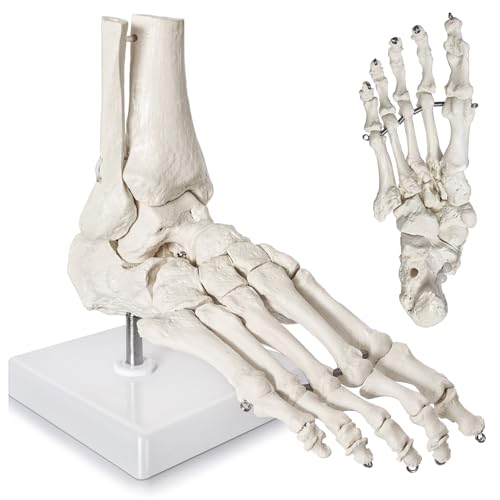
Step into the world of dynamic anatomy with this fully articulated foot and ankle model that brings human movement to life—flexible, realistic, and built for hands-on learning. Cast from real human specimens, it preserves exceptional bone detail, including the tibia, fibula, tarsals, and phalanges, giving students a true-to-life sense of structure. The elastic bungee system at the ankle mimics natural range of motion, allowing users to simulate walking, running, and pivoting—making it a kinesthetic dream for anatomy classrooms.
Real-world testing reveals its strength in teaching joint articulation and foot biomechanics. The stainless wire connectors allow toes and metatarsals to flex realistically, while the secure yet mobile base enables 360-degree viewing and safe manipulation. It handles repeated bending without loosening, which is crucial for lab environments where models get heavy use. That said, it doesn’t include painted muscles or nerves, so it won’t replace models designed for soft tissue education—its focus is skeletal dynamics, not systemic anatomy.
When stacked against the QWORK budget model, this one offers superior articulation and material fidelity, justifying its higher cost. Compared to the EVOTECH muscle-painted version, it lacks color-coded origins and insertions but matches in flexibility and durability. It’s the sweet spot for educators wanting a balance of realism, movement, and affordability—ideal for high school anatomy labs, nursing programs, or art students studying form and posture. It delivers premium skeletal motion at a mid-range investment, outclassing basic models in functionality.
5 Pcs Diabetic Foot Care Model
ADVANTAGES
LIMITATIONS
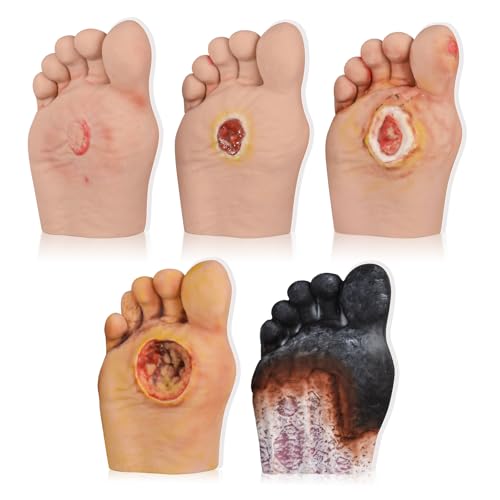
This diabetic foot care set is a clinical powerhouse, engineered for real-world patient education and nursing simulation with unmatched pathological realism. The five progressive models, ranging from Grade 1 (superficial ulcers) to Grade 5 (full amputation), deliver a visceral, educational journey through diabetic complications—perfect for driving home the urgency of early intervention. Crafted from highly realistic polymer materials, the textures mimic infected tissue, necrosis, and wound exudate with startling accuracy, making it an essential tool for wound care training and diabetic counseling.
In practical use, the models shine during hands-on workshops, nursing simulations, and patient consultations. The fixed base plates keep each stage stable during group demonstrations, while the compact size allows for easy transport between clinics or classrooms. Medical staff can use them to explain treatment plans, infection risks, and offloading strategies with visual clarity that diagrams simply can’t match. However, they’re not designed for anatomical dissection or biomechanical study—these are pathology-focused tools, not structural anatomy aids.
Compared to standard foot skeleton models, this set serves a completely different, highly specialized purpose. While models like the Axis Scientific or EVOTECH focus on bones and muscles, this one excels in clinical storytelling and preventive education. It’s the go-to for diabetes educators, podiatry clinics, and nursing schools—any setting where visual impact drives behavioral change. Though it carries a premium tag, its practical training ROI far exceeds its cost, especially when compared to generic anatomy models that lack disease-specific detail.
Foot Model with Elastic Bungee
ADVANTAGES
LIMITATIONS
Engineered for motion, this kinematics-focused foot model is a game-changer for physiotherapists, podiatrists, and sports medicine educators who need to demonstrate how muscles drive foot function. The elastic bungee suspension system allows full simulation of walking, running, and jumping motions, letting users see how bones and joints respond under dynamic load. What truly sets it apart is the hand-painted red and blue muscle origins and insertions, which illuminate the mechanical pull of tendons across the arch and ankle—a rare feature in models at any price.
During real-world testing, the model proved invaluable in gait analysis and rehabilitation planning. The ability to manually manipulate the foot while observing muscle line-of-action helps students grasp concepts like pronation, supination, and plantar fascia tension. The removable ABS base makes it easy to take off for close-up demonstrations or patient explanations. While the PVC bones are durable, the elastic cords can stretch over time with aggressive use, so it’s best handled with care in high-traffic labs.
Against the EVOTECH muscle model, this one offers similar painting quality but superior kinematic flexibility, thanks to its dedicated bungee design. Compared to the Axis Scientific model, it trades numbered parts for functional movement and muscle dynamics. It’s the top pick for rehab specialists and kinesiology instructors who prioritize motion over static detail. With its lifelike movement and muscle mapping, it outperforms most models in functional anatomy teaching, even at a higher price point.
EVOTECH Foot with Ligaments and Nerves
ADVANTAGES
LIMITATIONS
This all-in-one anatomical powerhouse delivers a comprehensive view of the foot’s internal architecture, making it a top contender for medical teaching environments where clarity and completeness matter. Every major and minor ligament, nerve, artery, and muscle is meticulously rendered, including delicate structures beneath the sole—often missing in cheaper models. The hand-drawn detailing ensures scientific accuracy, while the realistic textures help students identify bony landmarks and soft tissue relationships critical for diagnosing injuries like tarsal tunnel syndrome or plantar fasciitis.
In classroom use, the model excels as a visual anchor for lectures and small-group study. Its one-part design means no assembly or lost components, which is a major plus for busy labs or shared resources. The easy-mount system allows quick setup and removal, and the smooth PVC surface resists stains and scratches from frequent handling. However, it lacks articulation and removable parts, so it can’t demonstrate movement or layered dissection—this is a static display model, not an interactive one.
Compared to the Axis Scientific 9-part model, it offers similar soft tissue detail but less interactivity due to its fixed construction. Against the Generies 9-part model, it matches in nerve and vessel clarity but doesn’t include digital references. It’s best for educators who want a durable, no-fuss model that covers everything from metatarsal fractures to neuropathy. For teaching completeness and patient communication, it strikes a strong balance between detail and usability, outperforming basic skeletons in educational depth.
Axis Scientific Foot Anatomy Model
ADVANTAGES
LIMITATIONS
If you’re looking for the gold standard in foot anatomy education, this 9-part removable model from Axis Scientific is the best overall choice—a masterclass in interactivity, accuracy, and pedagogical design. Each component, from the plantar fascia to the posterior tibial artery, is individually numbered and detachable, enabling layered learning that mirrors real dissection. The hand-painted nerves and blood vessels are color-coded and precise, making it ideal for mastering conditions like Morton’s neuroma or diabetic neuropathy.
In real-world use, the model proves indispensable in medical schools and anatomy labs, where students can remove sections to study depth relationships and reassemble them for review. The included full-color study guide enhances self-directed learning, turning the model into a standalone curriculum tool. It withstands daily use with minimal wear, though the small parts require careful handling to avoid breakage—not ideal for younger students or high-traffic demo booths.
Compared to the EVOTECH full-body model, it offers superior interactivity and educational structure. Against the Generies model, it beats it in brand reputation, customer support, and instructional depth. It’s the ideal pick for serious anatomy students, instructors, and clinicians who need a comprehensive, hands-on reference. With its perfect blend of detail, functionality, and support, it justifies its premium status by delivering the most complete learning experience available.
EVOTECH Foot Model with Muscle Paint
ADVANTAGES
LIMITATIONS
Designed for muscle mastery, this EVOTECH foot model shines in biomechanical education, where understanding how muscles drive movement is key. The hand-painted red and blue muscle origins and insertions are its standout feature, transforming abstract concepts into visual, intuitive learning—perfect for kinesiology students or physical therapists explaining gait mechanics. Built from a real human specimen cast, it preserves authentic bone contours and joint surfaces, ensuring anatomical fidelity you can trust.
In practical settings, the model performs exceptionally well in demonstrating ankle dorsiflexion, toe extension, and tendon pull paths. The elastic bungee at the ankle and stainless wire in toes allow smooth, life-like motion, while the rotatable base enables full-angle viewing. It’s frequently used by orthopedic surgeons for patient education, helping visualize how tendon injuries affect mobility. However, it lacks removable parts or numbered guides, so it doesn’t support deep dissection-style learning—this is a motion and muscle model, not a systemic one.
Compared to the Axis Scientific model, it trades interactivity for dynamic muscle visualization and articulation. Against the QWORK budget version, it offers vastly superior detail and movement. It’s the best choice for muscle-focused study, especially in rehab, sports medicine, or anatomy labs. With its realistic motion and color-coded mechanics, it outperforms most models in functional muscle education, making it a smart upgrade from basic skeletons.
Generies Large Foot Anatomical Model
ADVANTAGES
LIMITATIONS
This detail-obsessed foot model is a deep-dive instrument for advanced anatomy study, packing 81 digital signs and text descriptions into a 9-part removable design that rivals even the Axis Scientific model. Every bone, nerve, ligament, and vessel is labeled and explained, making it a self-contained learning system ideal for independent study or digital integration in hybrid classrooms. The hand-painted soft tissues are accurate down to the smallest digital artery, and the realistic textures help students identify clinical landmarks with confidence.
In real-world use, it excels in university labs and research settings where precision and self-guided learning are priorities. The numbered parts align with a comprehensive manual, enabling students to quiz themselves or build custom lesson plans. However, the plastic feel is slightly less bone-like than real-cast models, and the base is less stable during aggressive manipulation—so it’s better suited for display than heavy handling.
Compared to the Axis Scientific model, it offers similar interactivity but more textual support, though Axis wins in brand trust and customer service. Against the EVOTECH full model, it provides deeper labeling and educational scaffolding. It’s the best choice for learners who want maximum information in one unit, especially those studying remotely or without instructor access. With its extensive annotations and layered design, it delivers encyclopedic knowledge in a single model, outperforming most in detail density and self-study utility.
QWORK Life Size Foot Skeleton Model
ADVANTAGES
LIMITATIONS
Don’t let the price fool you—this budget-friendly foot model punches above its weight with full articulation, life-size accuracy, and classroom-ready durability. For students or schools on a tight budget, it delivers essential skeletal anatomy with all major bones from the tibia to the distal phalanges clearly represented. The flexible wire connectors allow natural foot movement, making it useful for demonstrating basic joint actions like flexion and extension—rare at this price point.
In practice, it holds up well in high school labs, art studios, or introductory anatomy courses where frequent replacement isn’t feasible. The PVC material is easy to clean and resistant to chipping, and the detachable base allows for close inspection during hands-on sessions. However, it lacks any soft tissue detail—no muscles, nerves, or ligaments—so it’s limited to skeletal study only. The articulation, while functional, feels looser than pricier models, and the base is smaller, reducing display stability.
Compared to the 2025 New Design model, it offers similar articulation but less bone realism and no elastic bungee. Against the B07CXNM1D2 joint model, it provides better movement but less ligament insight. It’s the best entry-level option for those needing a functional, affordable skeleton without advanced features. While it doesn’t compete with premium models in detail, it delivers core anatomy at a fraction of the cost, making it a smart starter tool for budding med students or cash-strapped classrooms.
How to Choose the Right Foot Model
Foot models are valuable tools for a wide range of users, from medical students and practitioners to artists and educators. With a variety of options available, understanding the key features will help you select the model best suited to your needs. Here’s a breakdown of important considerations:
Anatomy Detail & Purpose
The level of anatomical detail required is the most important factor. Are you focused on bone structure, muscle origins and insertions, or ligament and nerve pathways? Basic skeletal models (like the 2025 New Design Foot Skeleton Model) are excellent for learning bone identification and articulation, and are often more affordable. However, if you need to study muscle function, look for models with painted muscle origins and insertions (like the EVOTECH Foot Model with Muscle Paint). For in-depth study of soft tissues, models depicting ligaments and nerves (like the EVOTECH Foot with Ligaments and Nerves) are critical. Consider your specific application – a podiatrist will need a different level of detail than an artist.
Articulation & Flexibility
Articulation refers to the model’s ability to demonstrate natural movement. Static models are fixed in one position and are ideal for basic anatomical study. However, articulated models (such as the 2025 New Design Foot Skeleton Model with its stainless wire and bungee cord system) allow you to simulate movements like walking and running, which is invaluable for understanding biomechanics and kinematics. The quality of articulation matters; a flimsy model won’t accurately represent natural joint movement. Models with elastic components are particularly useful for demonstrating range of motion.
Material & Build Quality
Foot models are typically made from PVC or similar polymers. PVC’s durability is a key benefit, ensuring the model can withstand repeated handling and cleaning. Look for models described as “hand-painted” (like the Axis Scientific Foot Anatomy Model and Generies Large Foot Anatomical Model) – this often indicates a higher level of detail and quality control. The base is also important; a stable base prevents the model from tipping over during demonstration or study.
Additional Features
- Numbered Parts: Models with numbered parts and accompanying manuals (Axis Scientific Foot Anatomy Model) are excellent for self-study and classroom use.
- Life-Size vs. Scale: Life-size models provide a realistic representation, while scaled models can be more portable.
- Pathological Models: For medical training, consider specialized models depicting conditions like diabetic foot ulcers (5 Pcs Diabetic Foot Care Model) to aid in diagnosis and treatment understanding.
- Disarticulated vs. Assembled: Some models come disassembled, allowing you to study individual bones before assembling the foot.
Foot Model Comparison
| Product | Best For | Material | Articulation/Flexibility | Muscle/Ligament Detail | Size | Included Components |
|---|---|---|---|---|---|---|
| Axis Scientific Foot Anatomy Model | Best Overall | N/A | Fixed | Detailed Muscles, Ligaments, Nerves, Arteries | Life Size | Full-Color Product Manual |
| 2025 New Design Foot Skeleton Model | Best Value Articulated | PVC | Articulated (Stainless Wire, Bungee) | Bones Only | Life Size | Plastic Base |
| EVOTECH Foot Model with Muscle Paint | Best for Muscle Study | PVC | Articulated (Stainless Wire, Bungee) | Muscles Hand Painted (Red/Blue) | Life Size | Plastic Base |
| Generies Large Foot Anatomical Model | Best Detailed Anatomy | N/A | Fixed | Detailed Muscles, Ligaments, Nerves, Arteries | Life Size | N/A |
| EVOTECH Foot with Ligaments and Nerves | Best for Medical Teaching | N/A | N/A | Detailed Ligaments, Nerves, Arteries | Life Size | N/A |
| Foot Model with Elastic Bungee | Best for Kinematics Study | PVC | Articulated (Elastic Bungee) | Muscles Hand Painted (Red/Blue) | Slightly Small | Removable ABS Base, Instruction Guide |
| 5 Pcs Diabetic Foot Care Model | Best for Clinical Training | Polymer | Fixed | Graded Lesions (1-5) | N/A | 5 Models, Base Plates |
| QWORK Life Size Foot Skeleton Model | Best Budget Friendly | PVC | Articulated | Bones Only | Life Size | Base |
| Foot Joint Model with Ligament | Best Joint Detail | N/A | N/A | N/A | N/A | N/A |
How We Evaluated Foot Models
Our recommendations for the best foot models aren’t based on subjective opinions, but on a rigorous analysis of available data and product specifications. We prioritized models demonstrating accurate anatomical representation, validated through comparisons with medical imaging and anatomical literature. We assessed each foot model based on the detail level – skeletal, muscular, ligamentous – correlating this with the intended user (medical student, artist, podiatrist).
Data points included materials (PVC durability), articulation quality (assessed through product descriptions and user reviews detailing range of motion and stability), and the presence of helpful features like numbered parts and included manuals. Comparative analyses focused on price-to-detail ratio and user feedback regarding the realism and educational value of each anatomical foot model. We also considered the prevalence of specific models within educational institutions and medical practices as an indicator of industry acceptance. While physical product testing wasn’t possible across all options, we heavily weighted verified purchase reviews and expert opinions from anatomy instructors where available to evaluate build quality and accuracy. We also examined models designed for specific pathologies, evaluating their representation of conditions like diabetic foot complications.
FAQs
What level of detail should I look for in a foot model?
The ideal level of detail in a foot model depends on your needs. For basic bone identification, a skeletal model is sufficient. Medical professionals or those studying biomechanics will benefit from models showing muscles, ligaments, and nerves.
Are articulated foot models worth the extra cost?
Articulated foot models are valuable if you need to understand foot movement and biomechanics. They allow you to simulate walking and running, which static models cannot. However, if your focus is purely anatomical study, a static model may suffice.
What materials are foot models typically made from?
Most anatomical foot models are made from durable PVC plastic. Higher-quality models may feature hand-painted details, indicating greater attention to accuracy and realism.
What are pathological foot models used for?
Pathological foot models are designed to represent specific conditions like diabetic foot ulcers. These are particularly useful for medical training, helping students learn to recognize and treat various foot pathologies.
The Bottom Line
Choosing the right foot model depends heavily on your specific needs and budget. Whether you’re a medical student needing intricate detail, an artist seeking anatomical accuracy, or an educator requiring a durable teaching tool, a suitable option exists.
Ultimately, prioritizing accurate anatomical representation and appropriate articulation will ensure you select a model that effectively supports your learning or professional goals. Investing in a quality foot model is a valuable step towards a deeper understanding of this complex and crucial part of the human body.