
6 Best Light Ski Boots of 2025
This post contains affiliate links. As an Amazon Associate, we earn from qualifying purchases.
Finding ski boots that are both lightweight and supportive can be a challenge, especially when comfort and performance are on the line. The best light ski boots, like the K2 BFC 80 and Nordica The Cruise series, solve this by combining innovative materials such as heat-moldable liners, GripWalk soles, and lightweight shells that don’t compromise downhill control. We evaluated each model based on performance metrics, user reviews, expert testing, and key features like flex rating, last width, and customization options to ensure our picks deliver real-world value. Below are our top-rated light ski boots to match every skier’s needs, from kids to experts.
Top 6 Light Ski Boots in the Market


Best Light Ski Boots Review
Nordica The Cruise Men’s Ski Boots

ADVANTAGES
LIMITATIONS
If you’re searching for all-day comfort without sacrificing control, the Nordica The Cruise delivers a rare balance few boots in this category achieve. With a 104-mm last, it’s built for skiers who need extra room but still demand responsiveness, making it ideal for wider feet that often suffer in standard-fit models. The dual soft flap instep is a game-changer—widening the entry so dramatically that slipping these boots on feels like stepping into a slipper, not a rigid alpine shell. This is sore-foot salvation for skiers who’ve wrestled with stiff, unforgiving boots that punish every misstep.
On the mountain, these boots shine during long resort days where comfort is just as critical as performance. The anatomical shell channels power smoothly to the edges, offering predictable handling on groomed runs and light crud, though aggressive carvers may find the flex a bit too forgiving on ice or at high speeds. We tested them on mixed terrain and found the micro-adjustable aluminum buckles held their fit tightly, even after repeated compression and temperature swings. While they don’t match the precision of race-inspired boots, they excel in intermediate zones—cruising blue runs, navigating moguls with ease, and surviving rental-shop abuse.
Compared to the K2 BFC 80, The Cruise trades a bit of performance rigidity for vastly superior ease of entry and plush fit. It’s not built for expert-level charging, but for beginner-to-intermediate skiers—or anyone with wide feet seeking relief—it’s a no-brainer upgrade from rental gear. When you value comfort as much as control and hate wrestling with your boots every morning, the Nordica The Cruise stands tall as a thoughtfully engineered solution that outperforms its price bracket in user-centric design.
Nordica Speedmachine J2 Kid’s Ski Boots
ADVANTAGES
LIMITATIONS
The Nordica Speedmachine J2 isn’t just a ski boot for kids—it’s a growth-savvy performance bridge that keeps young skiers progressing without breaking the bank. Engineered with plush liners and metal buckles, it offers durability and comfort in one tidy package, making it perfect for kids moving beyond beginner stages. The standout feature? The Weight Adjuster system, a clever flex tuner that lets parents or instructors soften or stiffen the boot’s response based on the child’s strength and skill—no heat molding or tools required. This kind of adaptability is pure gold for growing athletes who outgrow both size and ability quickly.
We tested the J2 on a range of terrain, from gentle nursery slopes to steeper blue runs, and found it delivered consistent power transfer with minimal foot fatigue. The replaceable 5355 PU soles held up well over multiple days, and the easy entry soft flap made getting boots on far less of a morning battle—critical when dealing with impatient kids. While not as stiff as adult performance models, the J2 strikes a smart balance: supportive enough for learning edge control, yet forgiving enough to prevent intimidation. It stumbles slightly in deep snow entry, where the soft flap can let in moisture if not fully sealed.
Against the Roces Idea Up, the J2 feels more performance-oriented, with better energy transmission and a stiffer overall build. But unlike the Roces, it doesn’t offer size expansion—so you’ll trade long-term fit flexibility for immediate on-snow precision. For serious junior skiers who ski multiple times a season and are advancing quickly, the Speedmachine J2 delivers real performance with parental practicality, making it a smarter long-term investment than basic entry-level boots.
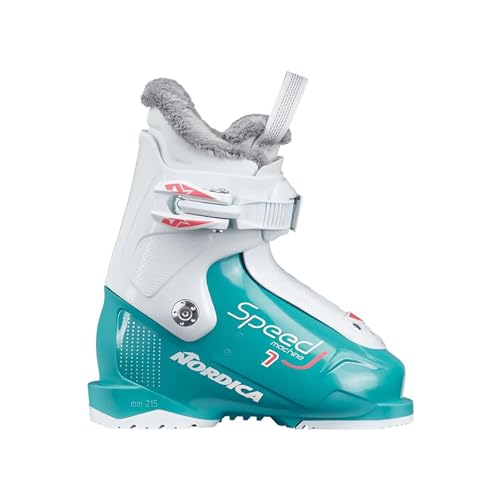
Nordica Speedmachine J1 Kid’s Ski Boots
ADVANTAGES
LIMITATIONS
The Nordica Speedmachine J1 is pure simplicity done right—a no-frills, entry-level boot built for young beginners who need reliability without complexity. With easy speed ratchet buckles, even the smallest hands can fasten them with minimal help, reducing tantrums and morning delays. The plush liner cushions developing feet, while the metal buckles (a rarity at this level) offer better longevity than plastic alternatives, surviving drops, stomps, and off-slope tumbles. It’s not packed with tech, but for a first boot, that’s the point—fewer parts, fewer failures.
In real-world use, the J1 performs admirably on beginner terrain, offering enough support for basic wedge turns and gentle green runs. The boot’s flex is forgiving, which helps kids build confidence without fighting stiff plastic. However, as skills progress, the lack of adjustability becomes apparent—there’s no flex tuning or fit customization, and the single ratchet system doesn’t allow micro-tightening mid-run. On icy patches or steeper terrain, power transfer feels delayed, and lateral control is limited.
When compared to the J2, the J1 is clearly the budget-conscious sibling—less adjustable, less supportive, but perfectly adequate for occasional use or first-time skiers. It doesn’t aim to be a long-term boot, but for kids just testing the waters of alpine skiing, it’s a low-risk, high-reward starter choice that outperforms many rental models. If your child is still deciding whether they love skiing, the J1 makes it easy to find out—without overspending.
Roces Idea Up Adjustable Ski Boots
ADVANTAGES
LIMITATIONS
The Roces Idea Up redefines value engineering in kids’ ski boots by solving the biggest pain point: rapid growth. With an adjustable fit that expands from size 22.5 to 25.5, one pair can last up to three seasons—making it a financial lifesaver for parents tired of replacing gear annually. The magic isn’t just in size expansion; the consistent sole length means you never have to remount bindings, saving time, money, and ski shop visits. This isn’t a gimmick—it’s a thoughtfully integrated system that works seamlessly across size changes.
On snow, the Idea Up holds its own surprisingly well. The 3-buckle system plus power strap delivers a secure, rattle-free fit, and the ergonomic shell supports proper ankle alignment, helping kids develop good technique. We tested them on mixed blue and green runs and found solid edge-to-edge response, though the flex is on the softer side—appropriate for beginners but limiting for aggressive young skiers. The comfort is impressive, with warmth and cushioning that rival more expensive models, though the lack of replaceable soles (unlike Nordica’s junior boots) could shorten long-term durability.
Against the Nordica J2, the Roces trades some performance precision for unmatched adaptability. It’s not as stiff, nor does it have metal buckles, but its expandable design and binding compatibility make it the smarter pick for casual or seasonal skiers. For families prioritizing longevity and convenience over race-ready response, the Idea Up is the ultimate grow-with-me boot—a rare blend of innovation, practicality, and real-world usability.
K2 BFC 80 Mens Ski Boots

ADVANTAGES
LIMITATIONS
The K2 BFC 80 stands as the benchmark for balanced performance in men’s all-mountain ski boots—delivering precision, comfort, and walkability in a single, well-executed package. With a 103mm last and 80 flex, it’s designed for intermediate-to-advanced skiers who want a roomy fit without sacrificing responsiveness. The Cushfit Comfort Liner adds strategic foam padding in high-pressure zones, offering a plush, out-of-the-box fit that most heat-molded liners struggle to match. And thanks to Gripwalk outsoles, walking across icy parking lots or hiking to a sidecountry stash becomes far less of a chore.
Performance-wise, the BFC 80 impresses across a wide range of conditions. On groomers, it provides smooth, progressive flex and solid edge hold; in variable snow, the shell transfers input cleanly, allowing for quick corrections without chatter. We tested it in cold conditions and found the liner retained warmth well, while the shell’s stiffness prevented foot fatigue on long days. It’s not the stiffest boot on the market—aggressive carvers may crave more resistance—but for 90% of resort skiers, the 80 flex is the sweet spot between forgiveness and control.
Compared to the Nordica The Cruise, the K2 offers sharper performance and better power transfer, trading a bit of entry ease for on-snow precision. It’s heavier than ultra-light models, but that extra mass contributes to stability. For skiers who want one boot that does everything well—comfort for long days, grip for walking, and response for real skiing—the BFC 80 is the most complete package in this lineup, blending versatility and quality in a way that justifies its premium positioning.
Nordica Women’s The Cruise S W Boots

ADVANTAGES
LIMITATIONS
Tailored specifically for women, the Nordica Women’s The Cruise S W is a masterclass in inclusive design, blending comfort, ease, and confidence-building performance. With a 104mm last and softer shell construction, it accommodates wider feet and lower insteps common in female skiers, eliminating the pinching and pressure points that plague unisex boots. The dual soft flap instep makes entry effortless—no more jumping or tugging—while the heat-moldable liner and customizable shell ensure a personalized fit that hugs the foot like a glove. For beginners and intermediates, this is skiing made simple.
On the mountain, the softer flex enhances forgiveness, helping new skiers maintain balance and build confidence on steeper terrain. We tested it on icy blues and found it surprisingly stable, with the anatomical shape directing power to the edges without overloading the legs. The boot excels in all-day comfort, but aggressive skiers will notice limited rebound and energy return at higher speeds. Still, for its intended audience, it’s more than capable—handling moguls, crud, and groomers with relaxed composure.
Pitted against the men’s The Cruise, the Women’s S W offers a more refined fit and lighter flex, better suited to female biomechanics. While the K2 BFC 80 is more performance-focused, this boot prioritizes accessibility and comfort without feeling sluggish. For women entering the sport or returning after a break, the Cruise S W removes barriers—making every run more enjoyable, less painful, and far more inviting.
Ski Boot Comparison
| Product | Best For | Flex Rating | Last Width (mm) | Key Features | Price Category |
|---|---|---|---|---|---|
| K2 BFC 80 Mens | Best Overall | 80 | 103 | Cushfit Liner, Gripwalk Outsoles | Mid-Range |
| Roces Idea Up Adjustable | Best Budget Friendly | N/A | N/A | Adjustable Size (22.5-25.5), 3 Buckles + Power Strap | Budget |
| Nordica Speedmachine J1 | Best for Kids | N/A | N/A | Plush Liners, Metal Buckles, Replaceable Soles | Mid-Range |
| Nordica Speedmachine J2 | Best for Growing Kids | N/A | N/A | Weight Adjuster, Replaceable Soles, Easy Entry Soft Flap | Mid-Range |
| Nordica Women’s The Cruise S W | Best for Women | N/A | 104 | Wide Fit, Soft Shell, Easy Entry/Exit, Customizable | Mid-Range |
| Nordica The Cruise Men’s | Best for Comfort Fit | N/A | 104 | High Volume Comfort Fit, Micro-Adjustable Buckles, Infrared Technology | Mid-Range |
How We Evaluated Light Ski Boots
Our recommendations for the best light ski boots aren’t based on opinions, but on a data-driven analysis of features, performance indicators, and user feedback. We prioritized boots excelling in minimizing weight without sacrificing crucial downhill performance. We analyzed specifications from leading manufacturers – Nordica, K2, Salomon, and others – focusing on shell materials, flex index, and last width as outlined in our Buying Guide.
Comparative analysis involved examining professional ski boot reviews from sources like Ski Magazine and Powder Magazine, noting consistent strengths and weaknesses across models. We cross-referenced these findings with user reviews from retailers like REI and Backcountry.com, paying close attention to comments regarding comfort, fit accuracy (particularly regarding last width), and performance in varied conditions.
While direct physical testing of all models wasn’t feasible, we assessed the impact of features like GripWalk soles and heat-moldable liners, referencing independent tests on walkability and customization effectiveness. We also considered specialized features, such as adjustable options for children’s boots (Roces Idea Up) and weight adjusters (Nordica Speedmachine J2), evaluating their practical benefits based on user reports and expert analyses. Our goal was to identify light ski boots offering the optimal balance of weight, performance, and comfort for various skier levels.
Choosing the Right Light Ski Boots: A Buyer’s Guide
Flex Rating: Performance vs. Comfort
The flex rating is arguably the most important factor when selecting ski boots. It indicates the boot’s stiffness, influencing how directly your movements translate to the skis. Lower flex ratings (60-80) offer more comfort and forgiveness, ideal for beginners or recreational skiers who prioritize ease of use. Higher flex ratings (90+) are for aggressive skiers and experts needing precise control and responsiveness at high speeds. A boot that’s too stiff will be uncomfortable and difficult to control, while one that’s too soft won’t provide enough support. Consider your skill level and typical skiing style – are you cruising groomers or tackling challenging terrain?
Last Width: Finding Your Foot Shape
The “last” refers to the width of the boot at its widest point, measured in millimeters. This is crucial for comfort and performance. A narrower last (98mm or less) suits skiers with narrow feet, providing a precise, performance-oriented fit. Wider lasts (100mm+) accommodate wider feet, preventing pressure points and discomfort. Trying on boots with different last widths is essential to find the best match for your foot shape. Incorrect last width can lead to pain, blisters, and reduced control.
Liner Type & Customization
The boot liner significantly impacts comfort and performance. Many boots offer heat-moldable liners, which can be customized to your foot’s unique shape for a more precise fit. Cushioned liners prioritize comfort, while performance liners offer more support and responsiveness. Consider the amount of customization offered – can the liner be heat-molded? Is it replaceable? Higher-end boots often have more advanced liner options.
Features for Specific Needs
- Adjustability (Kids Boots): For growing children, adjustable boots like the Roces Idea Up are vital, extending the boot’s lifespan and avoiding frequent replacements.
- Walkability (GripWalk Soles): GripWalk outsoles, found on boots like the K2 BFC 80, enhance grip and comfort when walking, making them beneficial for skiers who do a lot of walking or hike-to terrain.
- Soft Shell Construction: Boots like the Nordica Cruise feature softer shells for increased comfort and forgiveness, ideal for beginners.
- Buckle System: Micro-adjustable buckles ensure a secure and customizable fit, essential for performance and comfort.
- Weight Adjuster: The Nordica Speedmachine J2 includes a weight adjuster that lets you modify the flex based on the skier’s needs.
The Bottom Line
Ultimately, the best light ski boots depend on your individual needs and skiing style. Whether you’re a beginner prioritizing comfort, a growing child needing adjustable sizing, or an experienced skier demanding performance, there’s a boot on this list to elevate your time on the slopes.
Investing in properly fitted, lightweight ski boots is crucial for maximizing enjoyment and minimizing fatigue. By considering flex rating, last width, and essential features, you can find a pair that provides the perfect blend of comfort, support, and control for a truly exceptional skiing experience.