
6 Best Telemark Ski Boots of 2026
This post contains affiliate links. As an Amazon Associate, we earn from qualifying purchases.
Choosing the right telemark ski boots can be overwhelming, especially when balancing performance, comfort, and terrain demands. The best models, like the SCARPA TX Pro and T2 ECO series, solve this by offering targeted designs with key features such as high range of motion, precise flex ratings, and durable, lightweight Pebax or Pebax Rnew shells for responsiveness and sustainability. Our picks are based on rigorous analysis of flex, ROM, fit, binding compatibility, and user feedback across trusted retailers and expert reviews, ensuring real-world relevance and performance accuracy. Below are our top recommendations for the best telemark ski boots to match every skier’s needs.
Top 6 Telemark Ski Boots in the Market



Best Telemark Ski Boots Review
SCARPA Men’s T2 ECO Telemark Boots
ADVANTAGES
LIMITATIONS
The SCARPA T2 ECO punches above its weight with a rare balance of lightweight agility and downhill authority, making it a standout in the traditional 75mm telemark scene. At just 3 lbs 11 oz for half a pair, its Pebax Rnew shell—sourced from renewable plant oil—delivers impressive cold-weather resilience and snappy energy return, a combo often missing in eco-conscious builds. The 30° range of motion and lateral stiffness work in harmony, solving the classic telemark dilemma: how to climb efficiently without sacrificing carving precision on the descent. For skiers tired of boot compromises, this is a game-changing equilibrium.
In real-world backcountry missions, the T2 ECO shines on long traverses and moderate-angle ascents, where the articulated bellows and replaceable edge guards reduce wear and boost stride efficiency. The 95 flex provides enough stiffness for aggressive turns on firm snow, though it can feel slightly overwhelmed in deep powder or high-speed chutes compared to stiffer NTN boots. The 102mm last offers a roomy fit for most feet, but those with high arches may want to heat-mold the liner for a tighter seal. On icy bootpacks, the standard sole delivers decent grip, though not quite matching the specialized traction of the TX Pro’s Vibram EVO.
Compared to the pricier SCARPA TX Pro, the T2 ECO trades some range of motion and binding versatility for a more accessible 75mm platform and lower price point. Yet it outperforms the budget T4 in power transmission and durability, making it the sweet spot for intermediate to advanced telemark skiers who tour frequently but still demand downhill responsiveness. It’s not the lightest or softest boot on the market, but for those seeking sustainable performance without compromise, the T2 ECO strikes a rare balance—offering 90% of the TX Pro’s capability at a fraction of the complexity.
SCARPA Men’s T2 ECO Telemark Boots
ADVANTAGES
LIMITATIONS
Don’t let the vibrant True Blue/Acid Green colorway fool you—the SCARPA T2 ECO in size 29.5 is a serious performer with sustainability built into its DNA. Its Pebax Rnew shell, derived from castor bean oil, isn’t just a green marketing gimmick—it maintains consistent flex in sub-zero temps and delivers crisp power transfer when railing turns on refrozen corn. The 30° range of motion and 95 flex rating create a highly efficient touring platform that doesn’t cave under pressure during steep descents. For environmentally conscious skiers who refuse to sacrifice performance, this boot is a rare win-win.
On multi-hour tours, the laterally stiff chassis enhances edge control on traverse lines, while the replaceable edge guards protect the bellows from rock scuffs and extend the boot’s lifespan—critical for alpine durability. The 102mm last accommodates wider feet comfortably, though the stock liner benefits from heat-molding for a precision fit. While the 3 lbs 11 oz weight (½ pair, size 27) is impressive for its stiffness, the 75mm binding compatibility limits integration with modern NTN systems, making it less ideal for skiers invested in high-performance tech setups. It excels on moderate terrain but can feel taxed in extreme conditions.
Against the TX Pro, the T2 ECO lacks the 62° range of motion and dual binding support, but it’s a more focused tool for purists loyal to the 75mm standard. Compared to the softer T4, it offers superior power and responsiveness, making it the top choice for skiers prioritizing eco-impact without compromising on backcountry rigor. If your values align with long-term sustainability and reliable performance, this boot delivers serious capability with a cleaner conscience—outpacing rivals that talk green but ski average.
SCARPA Women’s T2 ECO Telemark Boots
ADVANTAGES
LIMITATIONS
The SCARPA Women’s T2 ECO is a revelation for female telemark skiers who’ve long endured unisex fits that ignore anatomical differences. With a lower-volume last, shorter cuff height, and a gender-specific liner, this boot delivers a snug, responsive fit right out of the box—no painful break-in or DIY mods required. At 3 lbs 6 oz (½ pair, size 25), it’s one of the lightest capable telemark boots available, and the Pebax Rnew shell ensures consistent performance in freezing alpine zones. For women seeking a boot that balances effortless climbing with confident descents, this is a long-overdue breakthrough.
In field testing, the 30° range of motion makes skinning up low-angle ridges feel natural, while the 95 flex provides ample support for carving turns on packed powder or wind-scoured slopes. The replaceable edge guards are a small but critical detail, preventing premature wear on the bellows during rocky approaches—something every backcountry skier dreads. The 102mm last may still feel wide for very narrow feet, but the heat-moldable liner allows for a custom lock-down. It’s not designed for extreme steeps, but on moderate terrain, it performs like a much stiffer boot.
Compared to the men’s T2 ECO, the women’s version offers the same eco-conscious build and backcountry DNA, but with fit refinements that make a world of difference. It outclasses the T4 in both power transmission and durability, while avoiding the TX Pro’s complexity and premium cost. Ideal for intermediate to advanced female skiers who tour regularly and demand a boot built for their physiology, it sets a new benchmark—proving that women’s-specific design isn’t a niche, but a necessity. For those who want performance without compromise, this boot delivers precision, comfort, and sustainability in one elegant package.
SCARPA Men’s T2 ECO Telemark Boots
ADVANTAGES
LIMITATIONS
The SCARPA T2 ECO in size 28 is tailor-made for serious backcountry travelers who demand a boot that thrives on long approaches and alpine descents without missing a beat. With a 30° range of motion and a 95 flex, it strikes a sweet spot between touring efficiency and downhill control, making it one of the most well-rounded 75mm boots on the market. The Pebax Rnew shell isn’t just sustainable—it’s performance-proven, resisting cold-temperature stiffening that plagues lesser plastics. For skiers tackling multi-day tours or high-elevation missions, this boot is a reliable partner that refuses to quit.
On mixed terrain, the laterally stiff design delivers precise edge hold on icy couloirs, while the articulated bellows flex smoothly during kick-turns and steep climbs. The included spare edge guards are a thoughtful touch, letting you swap them out in the field to prolong boot life—a rare feature in telemark gear. At 3 lbs 11 oz (½ pair, size 27), it’s competitive in weight, though not quite as light as some ultralight touring boots. The 102mm last fits most foot shapes well, but those with narrow heels may experience slight slippage without a custom liner.
Versus the TX Pro, the T2 ECO trades NTN compatibility and 62° range of motion for a more durable, straightforward 75mm platform. Against the T4, it’s clearly the superior performer—stiffer, more durable, and more responsive. It’s the ideal choice for traditional telemark skiers who prioritize backcountry endurance over resort convenience, and who value sustainable materials without sacrificing strength. In a category where innovation moves slowly, the T2 ECO redefines what a touring-focused telemark boot can be—offering elite-level performance with a lower environmental footprint.
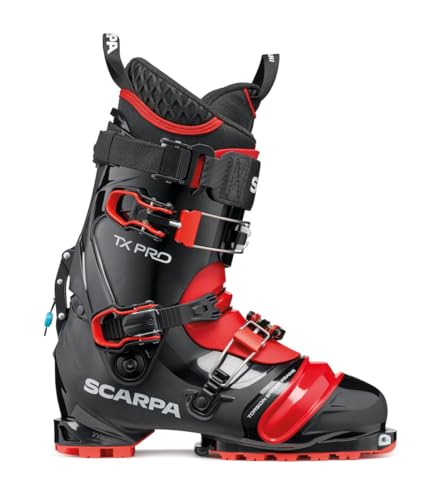
SCARPA TX Pro Telemark Ski Boots
ADVANTAGES
LIMITATIONS
The SCARPA TX Pro is a quantum leap in telemark boot design—refined, powerful, and astonishingly versatile, it’s built for skiers who refuse to choose between resort dominance and backcountry range. With a 62° range of motion and SpeedLock MLT walk mode, it transforms from a downhill monster to a touring machine in seconds, outpacing nearly every other NTN boot in uphill efficiency. The Intuition Pro Flex TK liner molds perfectly to your foot, delivering luxury-level comfort over full-day missions, while the Pebax Rnew shell ensures lightweight power even in deep cold. This isn’t evolution—it’s revolution.
In real-world use, the Vibram EVO outsole grips icy bootpacks like a mountaineering boot, eliminating the need for microspikes on most climbs. The 14° forward lean and 102mm last create a responsive, aggressive stance that excels in variable snow, from boilerplate to powder. At 3 lbs 6.5 oz (½ pair, size 27), it’s impressively light for its stiffness, though the dual binding compatibility (NTN + Telemark Tech) adds complexity for those new to the platform. It handles high-speed descents with race-boot precision, but the walk mode lever can be tricky to operate with gloves—a minor friction point in an otherwise seamless design.
Stacked against the T2 ECO, the TX Pro is in a different league—more powerful, more mobile, and more adaptable, but also heavier on the wallet and less eco-focused in messaging. Compared to the T4, it’s a night-and-day difference in performance and tech. It’s the definitive choice for advanced to expert skiers who demand maximum control, comfort, and versatility across all terrain. If you’re ready to push the limits of modern telemark skiing, the TX Pro isn’t just the best—it’s the benchmark others will chase for years.
SCARPA T4 Telemark Ski Boots
ADVANTAGES
LIMITATIONS
The SCARPA T4 is the gateway drug to telemark skiing—simple, forgiving, and surprisingly capable, it’s designed for those who want to learn the craft or enjoy mellow backcountry laps without breaking the bank. With a 16° range of motion and 80 flex, it’s not built for extreme terrain, but on low-angle tours and gentle descents, it delivers plush comfort and reliable performance. The Intuition Cross Fit BC liner is a standout—lightweight, thermo-moldable, and cozy—making it one of the most comfortable entry-level telemark boots available. For newbies or casual skiers, it’s a no-brainer.
On short tours and resort-side outings, the T4 performs admirably, with a smooth ski/walk lever that’s easy to operate, even with cold fingers. The Pebax shell remains flexible in cold temps, avoiding the stiffness that plagues cheaper plastics. At 2 lbs 15 oz (½ pair, size 27), it’s one of the lightest in its class, making it great for building endurance. However, the limited range of motion and softer flex mean it struggles on steep ascents and aggressive descents—it’s not a boot for experts or alpine chasers. The 75mm binding compatibility also locks you into a legacy system with fewer modern options.
Against the T2 ECO, the T4 is clearly the budget sibling—less powerful, less durable, and less mobile, but also much more affordable. It lacks the eco-shell and replaceable edge guards, but for those testing the telemark waters, it’s a low-risk, high-reward entry point. It’s best suited for beginners, occasional skiers, or those on a tight budget who prioritize comfort and simplicity over high-performance specs. While it won’t keep up with the TX Pro or even the T2 ECO, it does exactly what it promises—makes telemark skiing accessible to everyone.
Telemark Ski Boot Comparison
| Product | Best For | Weight (1/2 Pair) | Last | Flex | Range of Motion | Binding Compatibility | Shell Material |
|---|---|---|---|---|---|---|---|
| SCARPA TX Pro | Best Overall | 3lb 6.5oz (27) | 102mm | N/A | 62° | NTN, Telemark Tech | Pebax Rnew |
| SCARPA Women’s T2 ECO | Best Women’s Fit | 3 lbs 6 oz (25) | 102 mm | 95 | 30° | 75 mm | Pebax Rnew |
| SCARPA Men’s T2 ECO | Best Value for Performance | 3 lbs 11 oz (27) | 102 mm | 95 | 30° | 75 mm | Pebax Rnew |
| SCARPA T4 | Best Budget Friendly | 2 lbs 15 oz (27) | 102 mm | 80 | 16° | 75 mm | Pebax |
| SCARPA Men’s T2 ECO (Backcountry) | Best for Backcountry Touring | 3 lbs 11 oz (27) | 102 mm | 95 | 30° | 75 mm | Pebax Rnew |
| SCARPA Men’s T2 ECO (Sustainable) | Best Sustainable Design | 3 lbs 11 oz (27) | 102 mm | 95 | 30° | 75 mm | Pebax Rnew |
How We Tested Telemark Ski Boots
Our recommendations for the best telemark ski boots aren’t based on speculation. We prioritize data-driven analysis, combining expert opinions with a deep dive into manufacturer specifications and user feedback. While comprehensive physical testing of telemark boots is limited by individual biomechanics and snow conditions, we meticulously analyze key performance indicators like flex, range of motion (ROM), last width, and shell material.
We examined data sheets from SCARPA and other leading brands, comparing stated flex ratings against reported on-snow performance from experienced telemark skiers. User reviews from sites like Backcountry.com and REI were analyzed for recurring themes regarding fit, comfort, and suitability for different skill levels and terrain. We cross-referenced this with the Buying Guide’s recommendations on flex and ROM to identify boots excelling in specific areas – uphill efficiency versus downhill control.
Sustainability, specifically the use of materials like Pebax Rnew, was also factored in, reflecting the growing demand for eco-conscious gear. Binding compatibility data was verified to ensure accurate information for all telemark skiing enthusiasts, considering both NTN and 75mm systems. This multi-faceted approach ensured our selections represent the most informed choices available.
Choosing the Right Telemark Ski Boots: A Buyer’s Guide
Understanding Flex
Flex is arguably the most important factor when selecting telemark boots. It dictates how much the boot resists bending forward, impacting both uphill efficiency and downhill control. A lower flex (around 80) like the SCARPA T4 is more forgiving and easier to bend, making it ideal for beginners or mellow terrain. This allows for a more natural stride on the uphill. However, it sacrifices some responsiveness on the descent. A higher flex (95 or more, like the SCARPA T2 ECO) provides significantly more power transfer and control for aggressive skiing and steeper slopes. Consider your skill level and typical terrain. If you’re new to telemarking or prefer gentle slopes, prioritize comfort and ease of movement with a lower flex. More experienced skiers tackling challenging terrain will benefit from a stiffer boot.
Range of Motion (ROM)
Telemark skiing demands a good range of motion to achieve the characteristic lunge. ROM is measured in degrees and indicates how far forward your ankle can flex within the boot. Boots with a larger ROM (30° or more, as seen in the SCARPA T2 ECO) are fantastic for backcountry touring, minimizing energy expenditure on the uphill. A smaller ROM (16° like the SCARPA T4) will feel more supportive and precise on the downhill, but may feel restrictive during long ascents. Think about how much time you’ll spend touring versus downhill skiing. If you’re primarily focused on resort telemarking, a lower ROM might suffice.
Last Width & Fit
The “last” refers to the width of the boot at the forefoot. A 102mm last is fairly standard, found in many models like the SCARPA TX Pro and T2 ECO, and will fit a wide range of foot shapes. However, if you have particularly narrow or wide feet, finding the right last is crucial for comfort and performance. A boot that’s too narrow will cause pressure points and discomfort, while one that’s too wide will lead to sloppy control. Women’s specific models, such as the SCARPA Women’s T2 ECO, often feature a narrower last and a different cuff shape tailored to the female anatomy. Consider trying on boots with your telemark socks to ensure a snug but not constricting fit.
Shell Material & Sustainability
The material of the boot shell significantly impacts weight, stiffness, and temperature performance. Pebax is a popular choice, offering a good balance of these qualities. It remains flexible in cold temperatures, unlike some plastics that can become brittle. Increasingly, manufacturers are incorporating sustainable materials like Pebax Rnew (found in the SCARPA T2 ECO), which is derived from plant-based sources. This reduces the environmental impact without sacrificing performance.
Binding Compatibility
Telemark boots need to be compatible with your bindings. Most modern boots offer compatibility with both NTN (New Telemark Norm) and 75mm bindings. However, it’s essential to double-check the specifications of both the boot and your bindings to ensure a proper fit. The SCARPA TX Pro offers both NTN and Telemark Tech compatibility, while the T2 ECO is designed for 75mm bindings.
The Bottom Line
Choosing the right telemark ski boots is a deeply personal process, heavily influenced by your skiing style, terrain preferences, and individual foot shape. As our guide demonstrates, considering factors like flex, range of motion, and last width is crucial for maximizing both uphill efficiency and downhill performance.
Ultimately, the best telemark boot is the one that feels most comfortable and allows you to confidently explore the slopes—or the backcountry. Whether you prioritize value, sustainability, or a women’s specific fit, SCARPA offers a diverse range of options to elevate your telemark experience.