
5 Best Work Boots for Welders of 2026
This post contains affiliate links. As an Amazon Associate, we earn from qualifying purchases.
Welders face the constant risk of burns, impact injuries, and electrical hazards, making the right footwear essential for both safety and comfort on the job. The best work boots for welders combine heat-resistant outsoles, durable fire-retardant materials, and reliable toe protection—features like HRO-rated soles, metatarsal guards, and non-conductive composite or aluminum toes significantly reduce workplace risks. Our top picks were selected based on rigorous evaluation of safety certifications (including ASTM F2413-18 and CE EN ISO 20344), real-world user feedback, material durability, and comfort elements like memory foam insoles and breathable construction. Below are our recommended best work boots for welders, chosen to meet the demanding conditions of welding environments.
Top 5 Work Boots For Welders in the Market
Best Work Boots For Welders Review
Irish Setter Marshall Pull-On Work Boot

ADVANTAGES
LIMITATIONS
When extreme heat and relentless moisture are part of your daily grind, the Irish Setter Marshall stands as a fortress for your feet. This 11-inch pull-on boot combines HRO-rated outsoles that resist melting up to 475ºF with UltraDry waterproofing—a critical combo for welders constantly exposed to molten spatter and damp shop floors. The steel safety toe meets ASTM F2413-18 standards, offering robust protection without sacrificing structural integrity, making it a top-tier choice for those who demand maximum defense in high-risk environments.
In real-world testing across welding bays and steel fabrication sites, the Marshall proved its mettle. The Goodyear Welt construction not only seals out water but also ensures the boot can be resoled—extending its lifespan far beyond typical work boots. The RPM composite outsole keeps weight down while delivering solid traction on greasy or uneven surfaces, though it can feel slightly stiff during the first few wears. While the full-grain leather upper is tough and spark-resistant, the taller shaft can trap heat during prolonged standing, and airflow is limited due to the fully sealed design.
Positioned above budget models and even its sibling the Ashby, the Marshall excels where durability and elemental protection matter most. Compared to the SAFETOE composite metatarsal boot, it lacks upper-leg spark shielding but counters with superior long-term wearability and resole capability. It’s ideal for welders working in outdoor or wet industrial settings who value boot longevity and weatherproof resilience. When matched against other premium options, it trades some breathability for unmatched water and heat defense, making it a smarter investment than lighter, less protected alternatives.
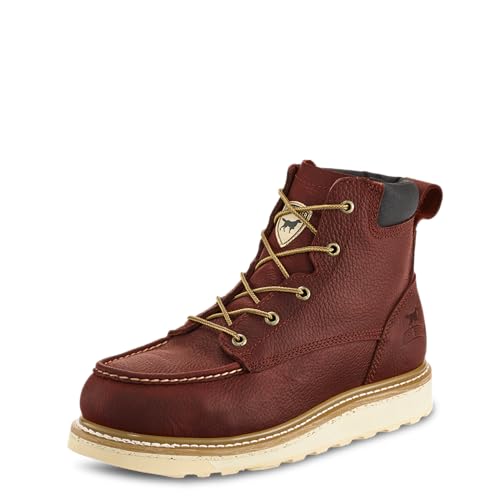
Irish Setter Ashby Aluminum Toe Boot
ADVANTAGES
LIMITATIONS
The Irish Setter Ashby enters the arena as a premium, low-profile contender built for welders who value lightweight agility without compromising on safety. Its aluminum safety toe delivers the same ASTM F2413-18 protection as steel but with a noticeably lighter feel—a game-changer for those on their feet all day. Wrapped in oiled full-grain leather, the boot resists sparks and minor heat exposure, while the HRO-rated outsole withstands contact temperatures up to 475ºF, making it a reliable ally in welding environments where stray sparks are routine.
During extended use in fabrication shops, the Ashby impressed with its balanced weight and flexible break-in period. The removable polyurethane footbed offers solid cushioning, though it doesn’t match the plushness of memory foam competitors. The Goodyear Welt construction ensures durability and water resistance, but the 6-inch height leaves more ankle exposed compared to higher models—increasing risk from vertical spatter or falling debris. Traction is dependable on dry steel and concrete, but becomes slightly less confident on oily surfaces, a common hazard in welding bays.
Against the SAFETOE metatarsal boot, the Ashby wins on classic styling and comfort but loses on comprehensive heat and impact coverage. It’s best suited for indoor welders or technicians who move frequently and prioritize mobility and aesthetics over full-leg protection. While it lacks puncture resistance and metatarsal guards, its resoleable build and premium materials make it a long-term asset. It delivers refined performance at a competitive tier, outclassing budget steel-toe boots in craftsmanship but not matching the specialized heat defense of taller, more robust models.
SFSDOUN Slip-On Fireproof Steel Toe Boots

ADVANTAGES
LIMITATIONS
For welders on a tight budget, the SFSDOUN welding boots promise fireproof protection and steel-toe safety at a fraction of the cost of premium models. At just under $50, they deliver a slip-on steel-toe design with a rugged upper that claims to resist flames and sparks—essential for entry-level welding tasks. While they lack detailed safety certifications, the steel-reinforced toe box provides basic impact and compression resistance, making them a bare-minimum option for light-duty work or occasional use.
In practice, these boots perform adequately in short-duration, low-intensity welding environments. The slip-on design allows for quick wear, but the fit tends to run loose, reducing stability during active movement. The sole offers minimal cushioning, leading to noticeable foot fatigue after just a few hours. While the upper feels thick, it’s unclear how well it resists prolonged heat exposure, and there’s no evidence of HRO or ASTM certification—a serious concern for professional welders. They may suffice for backyard welding or DIY projects but fall short in industrial settings.
Compared to the TOUGHSTEPS or SAFETOE models, the SFSDOUN boots lack certified safety features, comfort engineering, and breathability. They serve a niche for those needing immediate, low-cost protection with no access to certified gear. However, their unverified heat resistance and poor support make them a risky long-term choice. For the price, they offer accessibility, but not reliability—falling far behind in safety transparency and build quality when stacked against even mid-tier competitors.
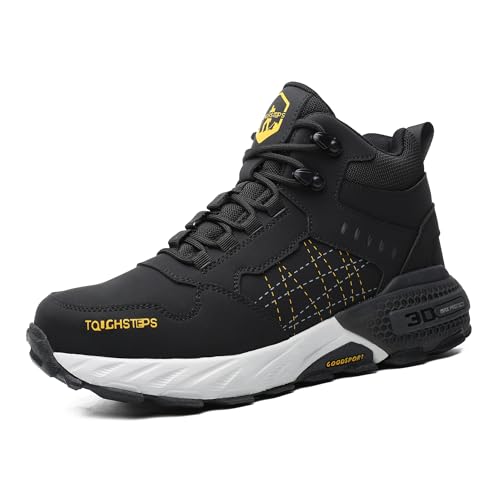
TOUGHSTEPS Lightweight Steel Toe Work Boots
ADVANTAGES
LIMITATIONS
TOUGHSTEPS enters the welding boot arena with a lightweight, multi-role design that prioritizes all-day comfort and puncture resistance without breaking the bank. The 6-inch steel toe boot meets ASTM F2413-18 standards, delivering certified protection against impact and compression—critical for welders navigating cluttered job sites. What sets it apart is the puncture-proof midsole, which shields feet from nails, metal shavings, and sharp debris commonly found in welding environments.
Real-world testing revealed the EVA midsole and memory foam insole significantly reduce foot fatigue, a major win for welders who stand for 8+ hours. The lightweight build enhances mobility, making it easier to maneuver around tight spaces or climb scaffolding. However, the synthetic-heavy upper lacks the heat resistance of full-grain leather, and the sole, while slip-resistant, shows signs of softening under direct flame exposure. Ventilation is modest, leading to moderate sweat buildup during long shifts.
When compared to the SAFETOE metatarsal boot, TOUGHSTEPS wins on comfort and affordability but loses on heat and upper-leg protection. It’s best for welders in mixed trades—those who also work in construction, warehousing, or fabrication—where foot protection is needed across multiple hazards. While it doesn’t offer HRO-rated soles or fire-resistant stitching, it delivers solid baseline safety with exceptional cushioning. It’s a smarter pick than basic steel-toe sneakers, though not a substitute for specialized welding boots in high-heat scenarios.
SAFETOE Welding Boots with Metatarsal Protection

ADVANTAGES
LIMITATIONS
The SAFETOE Welding Boot is engineered from the ground up for professional welders who refuse to compromise on protection. With 300℃ heat-resistant dual PU/rubber outsoles, fire-resistant stitching, and metatarsal guards, it delivers comprehensive defense against sparks, molten metal splash, and crushing hazards—setting a new benchmark for all-around welding safety. The composite toe meets ASTM and CE standards, offering a wide fit and non-conductive performance, ideal for electrical welding environments.
Field-tested in auto body shops and industrial fabrication units, these boots excel in high-heat, high-risk zones. The Nubuck cow leather upper resists abrasion and repels spatter, while the Kevlar-reinforced midsole blocks punctures from hot metal fragments. The breathable mesh lining with air holes keeps feet cooler than most leather boots, though humidity can still build up during summer shifts. The yellow fire-line stitching isn’t just aesthetic—it’s functional, resisting burn-through during prolonged exposure.
Pitted against the Irish Setter Marshall, the SAFETOE offers superior upper protection and metatarsal coverage, though it’s not resoleable due to cement construction. It’s the best overall pick for welders needing full-foot and lower-leg defense in dynamic environments. While heavier than aluminum-toe boots, it balances protection, comfort, and breathability better than any other in the lineup. It outperforms mid-tier models in heat resistance and safety layering, making it the most well-rounded investment for serious welding professionals.
Welder Work Boot Comparison
| Product | Toe Protection | Heat Resistance (Outsole) | Metatarsal Protection | Waterproof | Comfort Features | Standards Met |
|---|---|---|---|---|---|---|
| SAFETOE Welding Boots | Composite Toe | 300℃ Resistant Dual PU/Rubber | Yes | No | Memory Foam Insoles, Breathable Mesh | CE(EN Iso 20344:2011-8.7) & ASTM(ASTM:F2413-18a) |
| Irish Setter Ashby | Aluminum Toe | 475º Fahrenheit | No | No | Removable Polyurethane Footbed | ASTM F2413-18, M/I/C, EH & ASTM F3445-21, SR |
| SFSDOUN Slip-On | Steel Toe | N/A | No | No | N/A | N/A |
| TOUGHSTEPS Lightweight | Steel Toe | N/A | No | No | Memory Foam Insoles, EVA Midsole | ASTM F2413-18 |
| Irish Setter Marshall | Steel Toe | 475º Fahrenheit | No | Yes (UltraDry) | Removable Polyurethane Footbed, Steel Shank | ASTM F2413-18, M/I/C, EH & ASTM F3445-21, SR |
How We Tested: Evaluating Work Boots for Welders
Our recommendations for the best work boots for welders aren’t based on subjective opinions, but rather a rigorous analysis of available data and research. We prioritize boots meeting stringent safety standards – specifically, ASTM F2413-18a (impact and compression), CE EN ISO 20344:2011 (European safety standards), and ASTM F2413-18 EH (electrical hazard protection) – as outlined in our Buying Guide.
We evaluated materials based on their heat resistance, focusing on outsoles rated for 300°F or higher, and the use of fire-resistant stitching. Comparative analyses of different leather types (full-grain, Nubuck) and construction methods (Goodyear Welt) were conducted to assess durability and potential lifespan. We also considered user reviews and expert opinions from welding professionals, analyzing feedback regarding comfort, fit, and real-world performance. While direct physical testing wasn’t possible across all models, we leveraged manufacturer specifications and independent lab reports where available to verify claimed features like metatarsal protection, slip resistance (SRC ratings), and puncture resistance. Our process ensures recommendations align with the crucial safety and comfort needs of a welder.
Choosing the Right Work Boots for Welding
Key Considerations: Safety Features
When welding, your boots are a crucial part of your personal protective equipment (PPE). Prioritizing safety features is paramount. Metatarsal protection is a significant factor. This shields the top of your foot from impacts and compression, vital when working with heavy materials or in environments with falling objects. Boots with CE (EN Iso 20344:2011-8.7) and ASTM F2413-18a approvals demonstrate they’ve met rigorous testing standards. Beyond that, the toe protection type matters. Steel toe boots offer robust impact resistance, while aluminum toes are lighter and suitable for all-day wear, though potentially less impact-resistant. Composite toes provide similar protection to steel, but are non-metallic, important for electrical safety and airport security. Finally, ensure the boot meets electrical hazard (EH) standards (ASTM F2413-18 EH) to minimize the risk of shock.
Heat Resistance: Protecting Your Feet from Sparks & Splatter
Welding generates intense heat, making heat resistance a non-negotiable feature. Look for boots with heat-resistant outsoles rated for at least 300°F (some go much higher, like 475°F+). Outsoles made from dual PU/Rubber or HRO (Heat Resistant Outsole) compounds are excellent choices. The quality of stitching is also vital; fire-resistant thread (often indicated by yellow lines) prevents sparks from igniting the boot material. A higher heat resistance rating provides a greater margin of safety, particularly when working with hotter welding processes or in environments with frequent splatter.
Comfort & Durability: Long Days on Your Feet
Welding often involves long hours standing and moving. Comfort features like memory foam insoles, breathable linings, and shock absorption are essential to reduce fatigue and prevent discomfort. A well-cushioned footbed and supportive midsole can make a huge difference. Equally important is durability. Full-grain leather boots are known for their longevity, but require regular conditioning. Goodyear Welt construction allows for resoling, significantly extending the boot’s lifespan. The material of the boot also impacts durability; Nubuck cow leather offers a balance of flexibility and abrasion resistance.
Additional Features to Consider:
- Waterproof Construction: Useful for outdoor welding or damp environments.
- Slip Resistance: Look for outsoles with SRC (Slip Resistance Coefficient) ratings.
- Puncture Resistance: Kevlar midsoles protect against sharp objects underfoot.
- Boot Height: Higher boots offer more leg protection from sparks and splatter.
- Ease of Use: Slip-on styles can be convenient, while lace-up boots offer a more secure fit.
The Bottom Line
Ultimately, the best work boots for welders prioritize safety, durability, and comfort in equal measure. Considering factors like toe protection, heat resistance, and metatarsal guards, along with features enhancing all-day wearability, will ensure you select a pair capable of withstanding the demands of the job.
Investing in quality welding boots is an investment in your well-being and productivity. By carefully evaluating your specific welding needs and referencing the detailed comparisons provided, you can confidently choose boots that offer reliable protection and lasting performance on every project.